
Workflow Automation Strategy
How to Identify Workflow Bottlenecks Before Automating
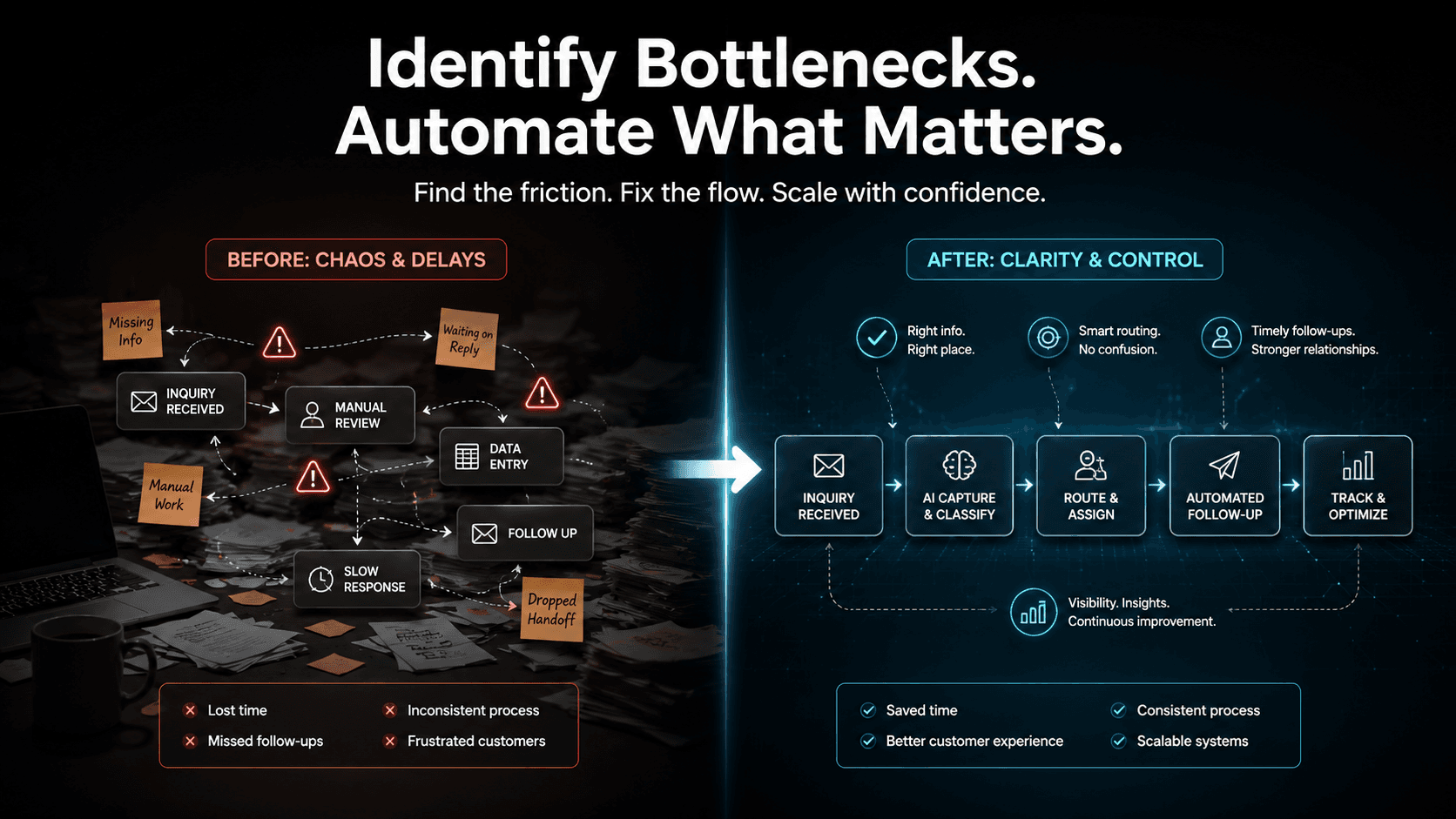
Automation should not be the first step
Visible bottlenecks
Some bottlenecks are easy to see because they create obvious delays, missed follow-ups, or repeated customer friction.
- •Work waits for one person to respond
- •Tasks stall between departments or systems
- •Customers ask for status updates repeatedly
- •Teams manually copy the same information
Hidden bottlenecks
Other bottlenecks are quieter. They sit inside decision rules, unclear ownership, inconsistent intake, or missing workflow visibility.
- •No one knows the correct next step
- •Important context is buried in email threads
- •Approvals depend on memory instead of rules
- •Reports are created manually after the fact
Start by mapping how work actually moves
Questions that expose bottlenecks
Bottlenecks become easier to see when the workflow is pressure tested with operational questions.
- •Where does work wait?
- •Where does information get copied?
- •Where do people ask the same questions?
- •Where does quality depend on memory?
Signals automation may help
Automation becomes useful when the workflow has repeatable patterns, clear inputs, defined routing, and predictable decision points.
- •The same intake steps happen repeatedly
- •Routing rules can be defined clearly
- •Manual summaries slow the team down
- •Status visibility is missing or delayed
Do not automate every bottleneck
Bottleneck audit example: lead intake and follow-up
Example 01
Lead intake bottleneck audit
Business Type
A service business receiving inquiries from website forms, email, referrals, and social messages.
Problem
Leads are arriving, but the owner does not have a consistent way to classify requests, identify missing information, assign priority, or trigger follow-up.
Before
Each inquiry is reviewed manually. Some details are copied into a spreadsheet. Follow-up depends on inbox discipline, memory, and who saw the message first.
After
The workflow is mapped into intake, classification, missing-information review, priority routing, owner assignment, and follow-up status. Only then should automation be added.
Expected Outcome
The business can reduce missed follow-ups, improve response consistency, and create a clearer path from inquiry to next action without automating confusion.
LuxNovare Lens
Weak automation target
A workflow is a weak automation candidate when the steps are unclear, the data is inconsistent, and every exception requires custom judgment.
- •No standard intake format
- •No defined owner for the next step
- •Decision rules change every time
- •Exceptions are more common than the normal path
Strong automation target
A workflow is a strong automation candidate when the trigger, inputs, decision rules, owners, handoffs, and outputs can be described clearly.
- •Clear workflow trigger
- •Repeatable input pattern
- •Defined routing logic
- •Known output or next action
Proof architecture: bottlenecks are measurable once the workflow is mapped
Verified System Proof
Workflow compression starts with bottleneck visibility.
When repeated manual work is mapped into a clear operating path, the bottleneck becomes visible enough to redesign.
3 hrs → 30 min
Workflow compression
Verified Job Search Pipeline GPT case-study result.
4 stages
Bottleneck review path
Trigger, intake, routing, and next action.
1 workflow
Best audit scope
Start with one high-friction workflow before expanding.
Before / After
From hidden drag to visible workflow friction
Before
- •Work waits inside inboxes, messages, or individual memory
- •Status is unclear until someone asks
- •The same information gets copied repeatedly
- •No one can identify the exact point of delay
After
- •Workflow trigger and intake path are mapped
- •Owners and routing points are clarified
- •Repeated delays become visible
- •Automation candidates are separated from process waste
A practical bottleneck review framework
Case-study proof: bottlenecks become visible when work is structured
The real goal is operational clarity

Author
Jose Aguilar
Jose Aguilar is the founder of LuxNovare. He focuses on AI-assisted workflow systems, operational architecture, product execution, subscription platforms, and scalable business process design.
Published by LuxNovare · Workflow Systems & AI Execution
Continue Exploring
Related workflow systems and services.
Workflow analyzer
Describe your workflow and get instant automation ideas.
Add a short description of a slow, repetitive, or inconsistent workflow. The analyzer will identify likely friction points and where automation can help.
Frequently asked questions
What is a workflow bottleneck?
A workflow bottleneck is a point in a process where work slows down, waits for approval, gets reworked, or depends too heavily on one person or manual handoff.
Should bottlenecks be fixed before automation?
Yes. Automating a broken workflow usually makes the broken process faster, not better. The workflow should be clarified before automation is applied.
What is the best way to find workflow bottlenecks?
Start by mapping where work enters, who touches it, where it waits, where information gets copied, and where decisions are delayed or repeated.
Continue Reading
Related workflow automation guides.
AI Workflow Automation Examples for Small Businesses
Five practical automation scenarios for small businesses.

What Is AI Workflow Automation?
A complete guide to AI workflow automation and implementation.

How AI Workflow Automation Improves Business Efficiency
How automation improves intake, handoffs, and visibility.
Find the friction before you automate the workflow.
LuxNovare helps businesses identify workflow bottlenecks, clarify operating logic, and design AI-assisted systems that improve execution instead of scaling chaos.