

Workflow Performance
How AI Workflow Automation Improves Business Efficiency
Efficiency improves when work stops depending on memory
Where efficiency is usually lost
Efficiency loss usually hides in routine work before it shows up as a major operational problem.
- •Manual intake and lead review
- •Repeated copying between systems
- •Unclear handoffs between people
- •Status checks buried in messages
- •Reports assembled after the fact
What efficient systems do differently
Efficient systems reduce the coordination burden around the work, not just the number of clicks inside a tool.
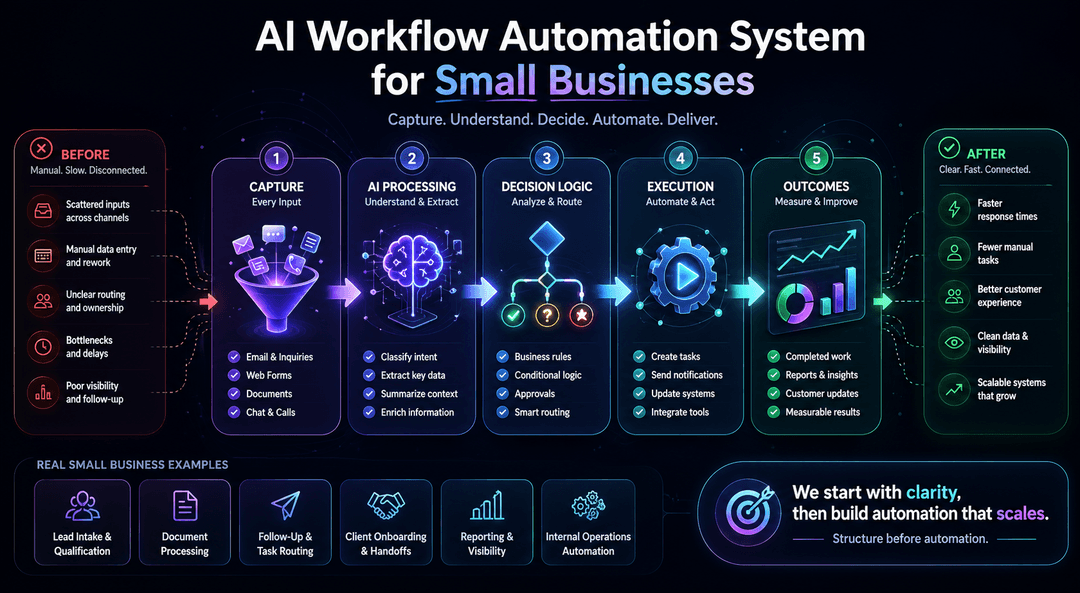
- •Capture information once
- •Classify and summarize inputs
- •Route work by defined logic
- •Trigger follow-up automatically
- •Create visibility without manual reporting
Three practical efficiency scenarios
Example 01
Lead intake and routing
Business Type
A service business receiving inquiries from website forms, referrals, email, and social messages.
Problem
The team spends time reading every inquiry, summarizing the need, deciding who should respond, and remembering which leads require follow-up.
Before
Leads are reviewed manually. Details are copied into a CRM or spreadsheet. Follow-up timing depends on inbox discipline and individual memory.
After
AI summarizes each inquiry, classifies the service type, flags missing information, scores urgency, and routes the lead to the correct next step.
Expected Outcome
Less manual triage, faster response time, fewer missed follow-ups, and cleaner qualification around revenue-generating work.
LuxNovare Lens
Example 02
Operations handoffs
Business Type
A small team moving work between sales, operations, delivery, support, or administration.
Problem
Work slows down when people rely on Slack messages, email threads, verbal updates, or manual reminders to know what should happen next.
Before
A task changes hands without consistent context. One person asks for status, another searches for details, and the next step depends on who remembers the workflow.
After
The system captures status, summarizes context, assigns the next owner, flags blockers, and creates a visible handoff record.
Expected Outcome
Fewer dropped handoffs, less status-chasing, more consistent execution, and better operating control as volume increases.
LuxNovare Lens
Example 03
Document review and processing
Business Type
A business that receives recurring forms, invoices, receipts, statements, applications, intake packets, or customer files.
Problem
People spend time opening files, extracting details, checking for missing information, naming documents, and preparing review summaries.
Before
Each file is reviewed manually. Important details are copied into another system. Missing information is discovered late.
After
AI extracts key fields, summarizes the contents, flags missing or low-confidence information, and prepares the item for human review.
Expected Outcome
Reduced review time, cleaner records, fewer late-stage surprises, and better visibility into the status of incoming work.
LuxNovare Lens
Efficiency gains should be measured as operating improvements
Low-quality efficiency
Low-quality efficiency speeds up activity without improving the workflow.
- •More notifications
- •Faster but messier routing
- •Automated confusion
- •No improvement in ownership
High-quality efficiency
High-quality efficiency improves execution quality while reducing manual coordination.
- •Cleaner intake
- •Clearer handoffs
- •Structured review points
- •Better visibility into work status
Proof architecture: efficiency comes from workflow compression
Verified System Proof
Efficiency improves when repeated work becomes structured.
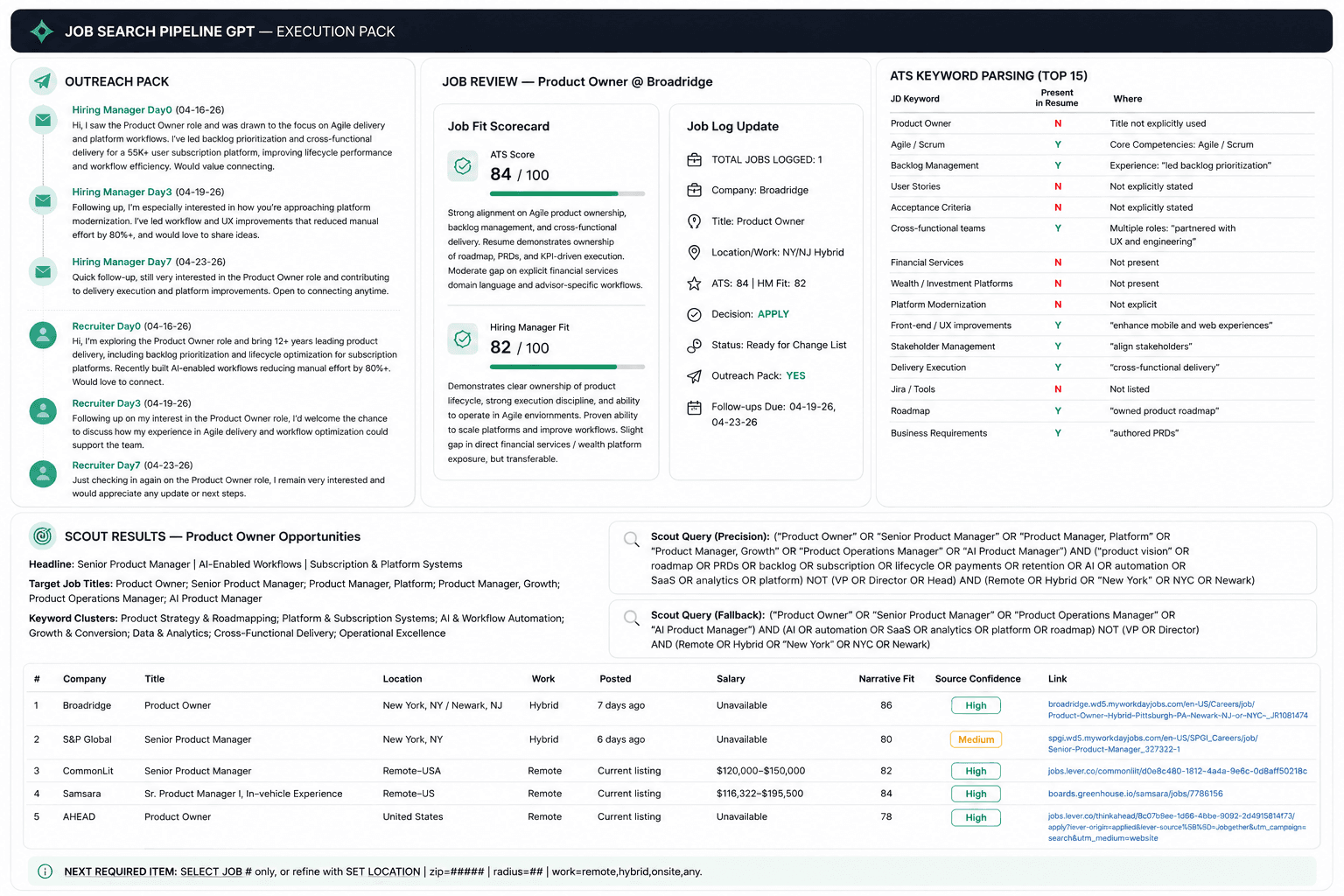
The clearest verified LuxNovare proof point is workflow compression: reducing repeated manual execution work by redesigning the workflow around structured intake, scoring, packaging, and tracking.
3 hrs → 30 min
Workflow compression
Verified Job Search Pipeline GPT case-study result.
84 / 100
ATS score example
Structured scoring layer inside the execution workflow.
82 / 100
Hiring manager fit
Decision-support scoring used to improve execution quality.
Before / After
From manual coordination to operating visibility
Before
- •Leads, tasks, and records reviewed manually
- •Status updates requested through messages
- •Follow-up dependent on memory
- •Reporting assembled after the work is already delayed
After
- •Inputs captured into a structured workflow
- •AI summarizes and classifies repeated work
- •Next steps routed through defined logic
- •Visibility created as the workflow executes
Case-study proof: repeated workflows need structure
Related LuxNovare System
Job Search Pipeline GPT
A deterministic workflow system that turned repeated research, scoring, packaging, execution, and tracking work into a structured operating pipeline.
Workflow Compression
3 hrs → 30 min
Why smaller teams often feel efficiency gains faster

Author
Jose Aguilar
Jose Aguilar is the founder of LuxNovare. He focuses on AI-assisted workflow systems, operational architecture, product execution, subscription platforms, and scalable business process design.
Published by LuxNovare · Workflow Systems & AI Execution
Continue Exploring
Related workflow systems and services.
Workflow analyzer
Describe your workflow and get instant automation ideas.
Add a short description of a slow, repetitive, or inconsistent workflow. The analyzer will identify likely friction points and where automation can help.
Frequently asked questions
How does AI workflow automation improve efficiency?
It reduces manual coordination, speeds up repeated steps, improves consistency, and lowers the amount of human effort required to move work from intake to completion.
What workflows usually create the biggest efficiency gains?
Lead intake, routing, follow-up, onboarding, document handling, reporting, and operational handoffs usually create the clearest efficiency gains.
Is automation only useful for large companies?
No. Smaller businesses often benefit quickly because recurring manual work consumes a larger share of operating capacity.
Continue Reading
Related workflow automation guides.

What Is AI Workflow Automation?
The foundation guide for AI workflow automation.
AI Workflow Automation Examples for Small Businesses
See practical workflow examples with before and after scenarios.

AI Automation for Small Business
How small businesses can automate without adding chaos.
Efficiency improves when the workflow becomes a system.
LuxNovare helps businesses redesign slow, manual workflows into structured systems built for faster execution, better control, and measurable business value.